Noise & Sound Barriers
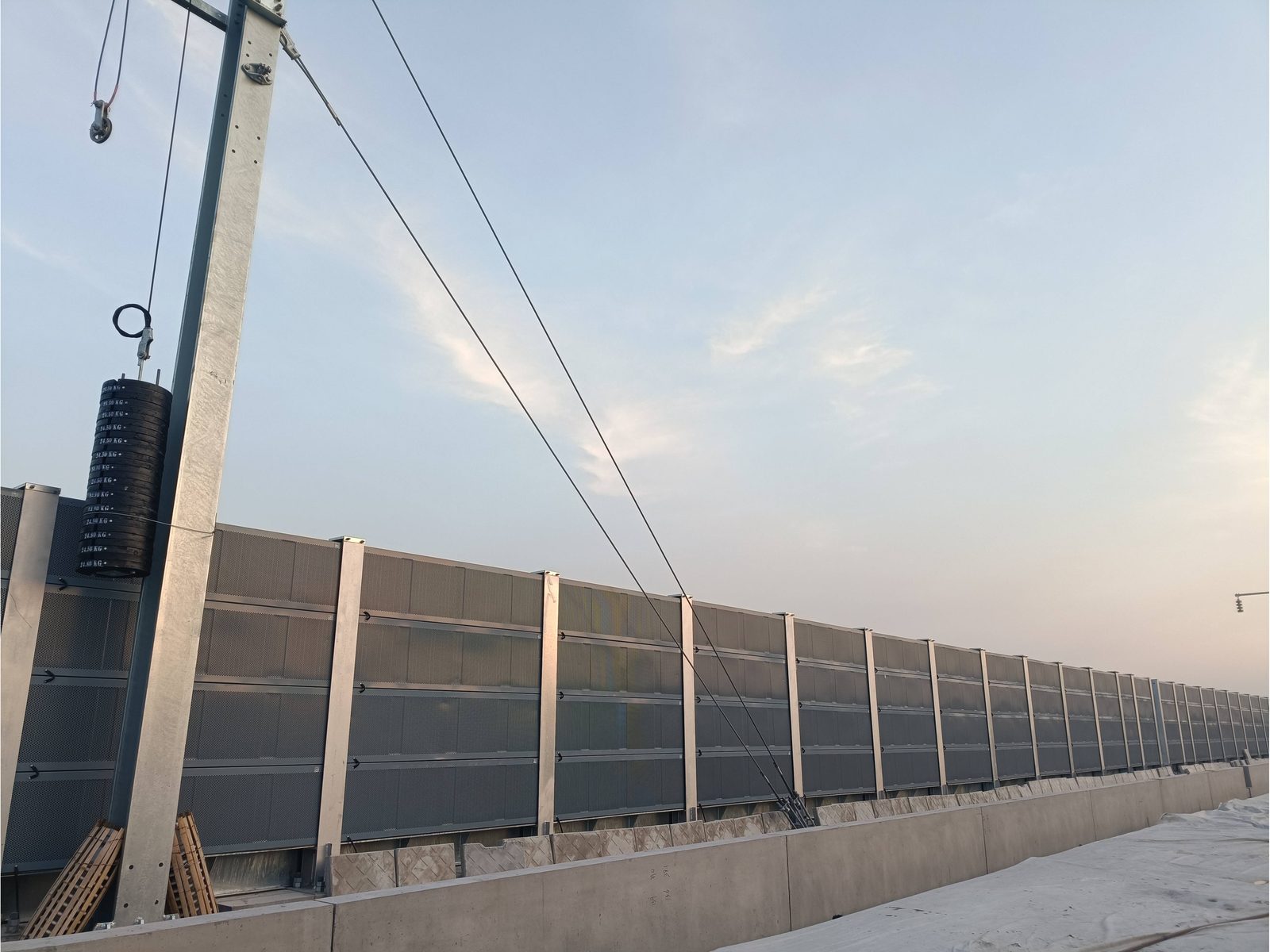
Noise barriers for road, highway, elevated road, railway and metro applications, supplied as upright, semi-enclosed and fully enclosed systems, plus folding-arm and portal-type enclosed structures. Panels are metal sound-absorbing elements or composite pinhole panels, with transparent PC, acrylic or laminated glass sections and steel or steel-frame support structures.
Barrier panels and posts are built as a rivet-free welded steel structure with full-insertion panel seating and a flexible connection that limits sound leakage at panel joints; a concave-convex interlock prevents panel drop-out. Steelwork passes shot blasting and acid pickling followed by a dual-paint, dual-powder galvanising and spraying process for maintenance-free corrosion resistance.
Selection is governed by barrier height, top geometry and whether a partial or fully enclosed structure is required. Field measurements across ten configurations recorded 10.6 to 12.3 dB at 10 m and 12.4 to 14.1 dB at 20 m behind vertical and curved barriers, and 19.3 dB and 20.4 dB for fully enclosed structures. Panels are installed as replaceable units to simplify later maintenance.
- EN 14388 — road traffic noise reducing devices — specifications and performance classes for barrier systems.
- ISO 10847 — acoustics — in-situ determination of the insertion loss of outdoor noise barriers of all types.
- EN 16272-2 — railway noise reducing devices — intrinsic characteristics: airborne sound insulation under diffuse sound field conditions.
- EN 1793-1 / -2 / -3 — road traffic noise reducing devices — test method for acoustic performance.
- EN 1794-1 / -2 — non-acoustic performance — mechanical and stability, and general safety requirements.
- EN 16272-1 — railway noise reducing devices — test method for determining acoustic performance.
Acoustic performance is stated as sound absorption and airborne sound insulation to EN 1793 for road and EN 16272 for rail, with non-acoustic performance — wind load, impact, safety — to EN 1794.
- Railway corridors — trackside barriers on main line, depot alignment and existing-line remediation works.
- Urban rail transit — elevated metro and light-rail viaducts running through residential areas.
- Municipal roads & overpasses — elevated expressways, interchange ramps and urban flyovers.
- Fully enclosed enclosures — total-enclosure structures where the highest insertion loss is required.
- Long-span sea crossings — wind barrier structures on major cross-sea bridge projects.
- Acoustic and structural test reports from an accredited laboratory, with testing capability covering 105 noise barrier indicators.
- Laboratory scope covers the structural, acoustic and railway barrier standards cited by the project.
- ISO 9001 quality management and ISO 14001 environmental management certification of the manufacturing base.
- Material certificates to EN 10204 3.1 for posts, panels and fixings.
- Wind load and deflection calculations for the barrier height and site exposure.
- Structural design, acoustic prediction and foundation coordination for the barrier line.
- Upright, semi-enclosed and fully enclosed systems, including transparent and roof sections.
- Export packing, FOB / CFR / CIF to Gulf ports/global ports, with installation supervision available.
Supplied to projects across the Gulf, North and Sub-Saharan Africa, South-East Asia and Australia. Middle East supplies are subject to project-specific approval by the owner, engineer or consultant; PROTEKTA prepares and supports the submittal package for that approval.
Noise & Sound Barriers — Buyer Questions
What barrier types are available?
Upright barriers, semi-enclosed and fully enclosed systems, U-trough structures and folding-arm or portal-type enclosures, with absorbing elements in metal concave-convex or composite pinhole panels. Supplied for projects across the GCC — Saudi Arabia, UAE, Qatar, Kuwait, Oman and Bahrain — and to Iraq, Algeria, Morocco, Nigeria, Ethiopia, Tanzania, Malaysia, Thailand, Singapore, Indonesia, Brunei and Australia, with compliance documentation prepared for consultant, contractor and authority submittal.
Which standards and certifications apply?
Acoustic performance is tested to EN 1793 for road applications and EN 16272 for rail, with the EN 16727 test method for determining acoustic performance. Non-acoustic performance — wind load, impact and safety — follows EN 1794, and structural steelwork is CE marked to EN 1090-1. Also specified and procured as Noise Barrier, Acoustic Barrier and Noise Wall; full specification ranges, material grades and datasheets are issued for tender, submittal and procurement use.
Can transparent sections be included?
Yes. Transparent boards and roof components are supplied in polycarbonate, acrylic or laminated glass where daylight and sightlines have to be retained. OEM, private-label and bespoke manufacture is supported for contractors, distributors and EPC packages.
Are barriers supplied for industrial noise control?
Yes. Enclosure forms are used around cooling towers, chillers and standby generators, including data centre generator compounds and cooling plant, to meet site boundary noise limits. Export packing, third-party inspection and consolidated shipment to Gulf ports/global ports are arranged with the order.