Fire-Resistant Joint Sealing & Firestopping
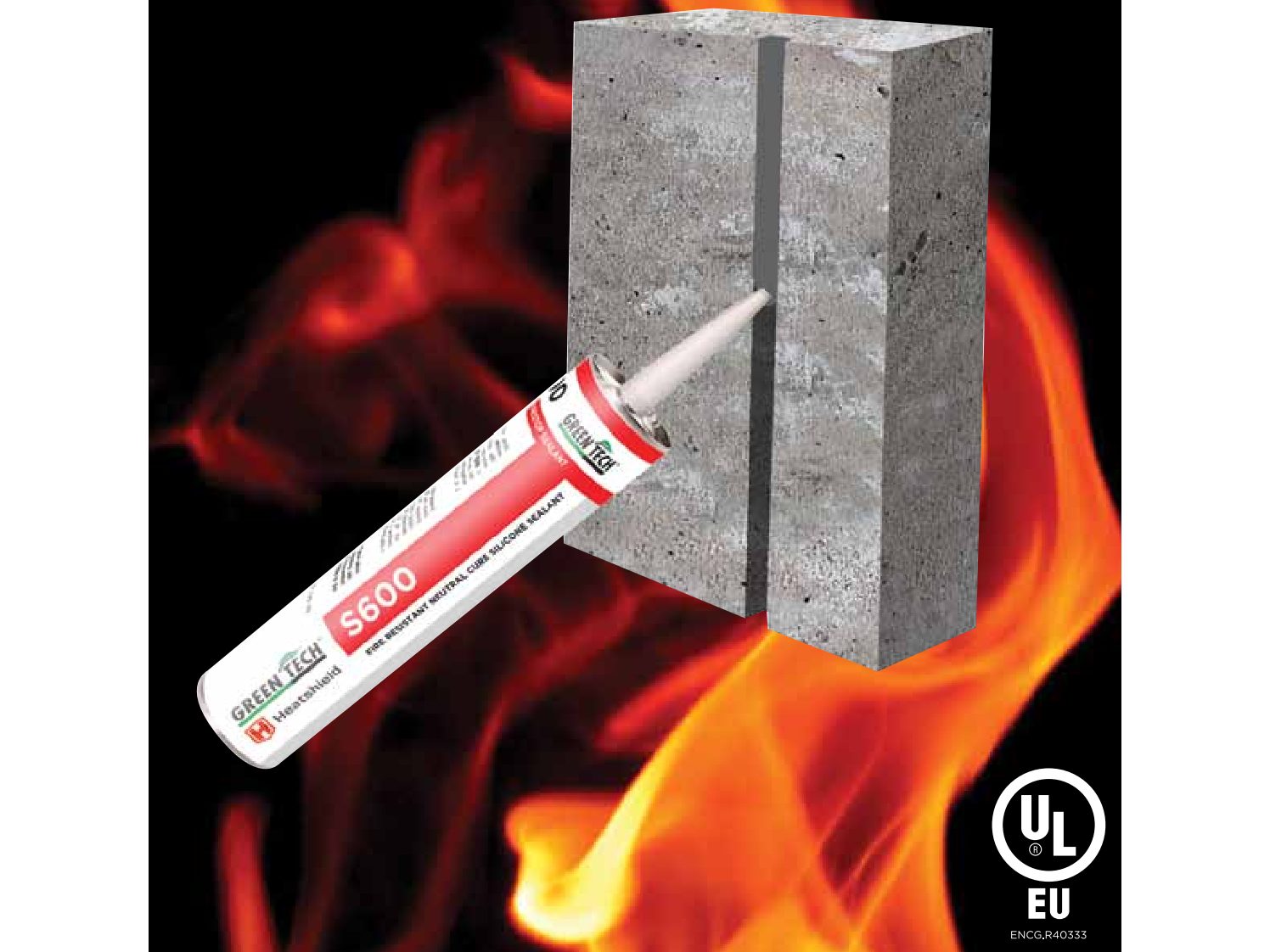
Fire-resistant sealing for linear joints and penetration annular gaps, reinstating the fire separation performance of compartment walls and floors. Used as firestopping around cable and pipe penetrations and for sealing construction and movement joints in fire-rated construction, forming a barrier that limits the passage of smoke and flame through the sealed opening.
Fire-rated movement joints are sealed with a low-modulus, one-component neutral-cure silicone that cures to a fire and smoke resistant elastomeric seal. The system is tested to EN 1366-4 for linear joint seals and carries a fire resistance of up to 4 hours. It bonds to porous and non-porous substrates without priming, and is used on facades and curtain walls, prefabricated panel joints, partition walls, ventilation and smoke ducts, and around cable and pipe penetrations through fire-rated structures.
Low-movement interior joints use a one-part water-based intumescent acrylic that forms an inorganic crust under fire exposure, classified at 2 hours to BS 476 Part 20:1987. Penetration sealing uses one-component moisture-curing polyurethane foam rated up to 4 hours at B1 to EN 1366-4, plus a B2 grade rated up to 2 hours to DIN 4102 Part 2. Joints are backed with closed-cell polyethylene rod from 6 mm to 50 mm, and elastomeric grades accommodate ±25 % movement.
- EN 1366-4 — Fire resistance test for linear joint seals, basis of the 4-hour rating.
- BS 476-20:1987 — Method for determination of the fire resistance of building elements, 2-hour classification.
- EN 1366-3 — Fire resistance test method for penetration seals around pipes and cables.
- DIN 4102-2 — Fire behaviour classification referenced for the B2 polyurethane foam grade.
- ASTM E84 — Test method for surface burning characteristics, rated Class A.
- EN 13501-1 — Harmonised reaction-to-fire classification for sealants and foam products.
All ratings are specific to the tested substrate, joint geometry and build-up. The submittal states the tested configuration so it can be matched to the site condition.
- Commercial & High-Rise — perimeter curtain-wall and facade expansion joints.
- Healthcare & Education — fire-rated movement joints in ward and classroom partitions.
- Industrial & Process — penetration seals around cable trays and pipe bundles.
- Transport & Airports — linear joint seals in terminal floor slabs and tunnels.
- Residential — service riser and apartment entrance door frame sealing.
- Utilities & Power — cable and conduit penetration sealing in substations.
- Oil & Gas — fire-rated sealing of pipe penetrations in plant walls.
- Data Centres — smoke-tight sealing of floor and wall service openings.
- EN 1366-4 fire resistance test report for linear joint seals
- BS 476 Part 20 fire resistance classification certificate
- EN 1366-3 fire resistance test report for penetration seals
- DIN 4102 fire classification report for polyurethane foam grades
- ASTM E84 surface burning characteristics test report
- ISO 9001 quality management system certificate and product data sheets
- Sealants, backing materials and primers supplied as one tested system.
- Penetration and joint schedules matched to the tested configurations.
- Export packing, FOB / CFR / CIF to Gulf ports/global ports, consolidated with fire doors and sealants.
Supplied to projects across the Gulf, North and Sub-Saharan Africa, South-East Asia and Australia. Middle East supplies are subject to project-specific approval by the owner, engineer or consultant; PROTEKTA prepares and supports the submittal package for that approval.
Fire-Resistant Joint Sealing & Firestopping — Buyer Questions
What fire rating is achieved?
Reported performance under the stated installation build-up is EI 240 for walls and EI 120 for floors, where EI denotes integrity and insulation in minutes. Ratings apply to the tested substrate, joint width and sealant build-up. Supplied for projects across the GCC — Saudi Arabia, UAE, Qatar, Kuwait, Oman and Bahrain — and to Iraq, Algeria, Morocco, Nigeria, Ethiopia, Tanzania, Malaysia, Thailand, Singapore, Indonesia, Brunei and Australia, with compliance documentation prepared for consultant, contractor and authority submittal.
Which standards and certifications apply?
Linear joint seals are tested to EN 1366-4 and penetration seals to EN 1366-3, with classification to EN 13501-2. Fire resistance testing to BS 476-20 is available where the project cites the British method, and ASTM E84 Class A data for surface burning characteristics. Also specified and procured as Fire Resistant Sealant, Penetration Seal and Linear Joint Seal; full specification ranges, material grades and datasheets are issued for tender, submittal and procurement use.
Where is fire-resistant sealing used?
Around cable and pipe penetrations through compartment walls and floors, in linear joints and head-of-wall gaps, and in annular gaps around services — anywhere fire separation has to be reinstated. OEM, private-label and bespoke manufacture is supported for contractors, distributors and EPC packages.
Is the rating valid for any joint?
No. Ratings are specific to the tested substrate, joint geometry and build-up. The submittal states the tested configuration so it can be matched to the site condition. Export packing, third-party inspection and consolidated shipment to Gulf ports/global ports are arranged with the order.