Sheet Waterproofing Membrane
Sheet and roll-applied waterproofing for below-grade structures, foundations, retaining walls, tunnels and buried concrete, and for roofs with upstands, parapets and flashings. The range covers self-adhesive and torch-applied modified bitumen membranes, vapour and steam barrier sheets, flashing membranes, roof underlayment and protection or isolation boards, with seam and junction detailing supplied with the system.
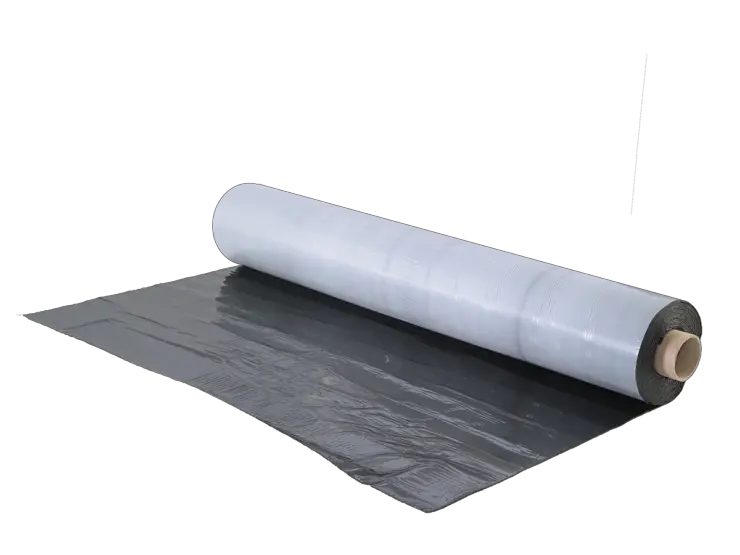
Manufactured range is a polyester-reinforced self-adhesive membrane made with tropical-grade SBS polymer-modified bitumen, faced with a non-perforated cross-laminated HDPE film. Thickness options are 1.6, 2.0 and 3.0 mm measured to EN 1849-1, over a 160 g/m² polyester carrier. Documented properties include tensile strength above 5 MPa, compound elongation above 1500%, tear strength of 350 N per 5 cm, puncture resistance above 800 N and softening point above 120 °C.
Protection courses of 3.5 mm self-adhesive membrane with polypropylene fleece are laid over the waterproofing, giving tensile strength of 700/550 N per 5 cm and puncture resistance above 1,800 N. Systems are cold-applied without torching, laid from low to high points over primed substrates, with side and end laps sealed using double-sided bitumen tape and star-cut detailing at corners and penetrations. Application temperature ranges from 10 to 45 °C.
- EN 1849-1 — determination of thickness and mass per unit area of the sheet membrane.
- EN 13707 / EN 13969 — reinforced bitumen sheets for roof waterproofing and for below-grade tanking.
- EN 13491 — geosynthetic barriers for below-grade waterproofing where cited.
- ASTM D412 / D5147 — tensile strength and tear strength of the membrane.
- ASTM E154 / D5385 — puncture resistance and hydrostatic pressure resistance, tested at 7 bar.
- ASTM C1305 / BS 8102 — crack bridging ability; protection of below-grade concrete structures.
Performance requirements and acceptance levels follow the project documents and the test report schedule. Lap integrity is verified by seam testing on site where specified.
- Foundations & raft slabs — below-grade tanking applied over primed concrete.
- Retaining walls — self-adhesive membrane with protection course against backfill damage.
- Tunnels & underpasses — sheet membranes combined with waterstops at construction joints.
- Water retaining & treatment structures — below-grade waterproofing for tanks, basins and plant structures.
- Damp-proof courses & plinths — fibre-reinforced bitumen DPC membranes at 1.5 mm and 3.0 mm.
- ISO 9001, ISO 14001 and ISO 45001 certification under national accreditation.
- Hydrostatic pressure resistance verified at 7 bar.
- Water vapour transmission below 0.1 g/m² per 24 hours and VOC content below 50 g/l.
- Water absorption below 0.15% over 24 hours; chemical resistance from pH 2.5 to 11.5.
- Per shipment: certificate of conformity, packing list, test reports and application guidance.
- Membranes, primers, protection boards and detailing accessories supplied as one package.
- Method statement, lap detailing and seam test procedure.
- Export packing, FOB / CFR / CIF to Gulf ports/global ports, consolidated with liquid membranes and waterstops.
Supply references include Etihad Rail, TAQA Distribution, ADDC/TAQA, Dubai Municipality, Emaar Development PJSC, Meydan Group LLC and Dubai Holding. Supplied to projects across the Gulf, North and Sub-Saharan Africa, South-East Asia and Australia. Middle East supplies are subject to project-specific approval by the owner, engineer or consultant; PROTEKTA prepares and supports the submittal package for that approval.
Sheet Waterproofing Membrane — Buyer Questions
What membrane types are available?
Self-adhesive modified bitumen, torch or heat-fused modified bitumen, self-adhesive vapour and steam barriers, flashing membranes, roof underlayment, and protection membranes or boards, with seam overlap detailing materials. Supplied for projects across the GCC — Saudi Arabia, UAE, Qatar, Kuwait, Oman and Bahrain — and to Iraq, Algeria, Morocco, Nigeria, Ethiopia, Tanzania, Malaysia, Thailand, Singapore, Indonesia, Brunei and Australia, with compliance documentation prepared for consultant, contractor and authority submittal.
Where are sheet membranes used?
Below-grade structures against groundwater, foundations and retaining walls, tunnels and buried concrete, flat and inverted roofs with upstands and parapets, podium decks, and tanking of water and wastewater structures. Also specified and procured as Sheet Membrane, Bitumen Membrane and Self Adhesive Membrane; full specification ranges, material grades and datasheets are issued for tender, submittal and procurement use.
Which standards and certifications apply?
Roof membranes are assessed to EN 13707, basement tanking to EN 13969, vapour control layers to EN 13967 and tunnels to EN 13491, with ASTM D6163 and D6164 available for modified bituminous sheet materials. OEM, private-label and bespoke manufacture is supported for contractors, distributors and EPC packages.
What testing is carried out?
Tensile strength, tear and puncture resistance, chemical and soil resistance, dimensional stability and lap integrity, with seam testing on site where specified and reaction to fire classification for exposed roof membranes. Export packing, third-party inspection and consolidated shipment to Gulf ports/global ports are arranged with the order.