Liquid Waterproofing Membrane
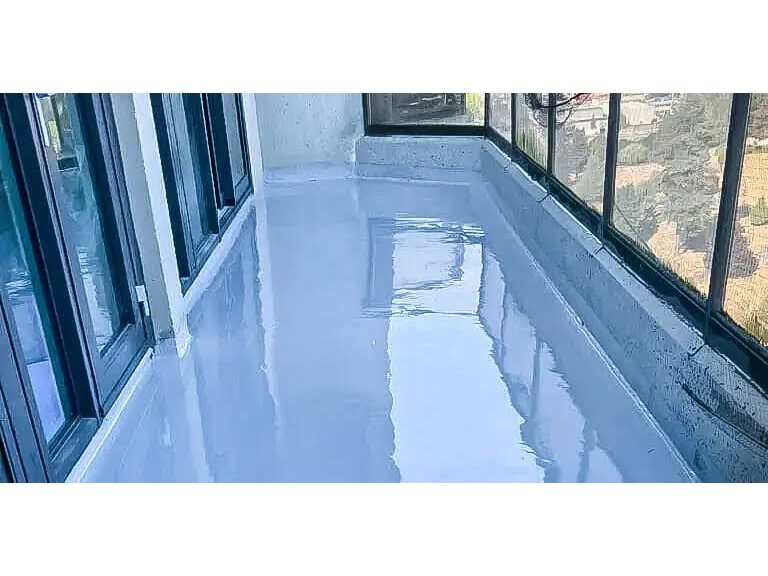
Fluid-applied waterproofing membranes that cure to a seamless, fully bonded barrier on roofs, terraces and balconies, wet areas, and water-retaining environments such as pools, water features and tanks. Systems comprise primers, patch and repair materials, reinforcement layers and finishing membrane coats, selected as a complete build-up rather than as single products.
Liquid-applied waterproofing covers polyurethane and polyurea coatings, hybrid urethane systems, water-based acrylic co-polymer roof coatings, two-component polymer-modified cementitious slurries and solvent-free epoxy systems. Materials are applied by brush, roller or airless spray in two or more coats on concrete, metal and existing bituminous substrates. A representative build-up is a 100 micron epoxy primer, intermediate coats at 200 microns DFT each and a 70 micron UV-resistant polyurethane topcoat. Hybrid urethane grades cure on damp substrates with initial set in about 30 minutes.
Cured films exceed 5 MPa tensile strength to ASTM D412 with elongation above 1500%; reinforced courses reach 700 and 550 N per 50 mm to EN 12311-1. Adhesion to primed concrete is 1.8 to 2.2 N/mm by ASTM D1000, and pull-off strength on concrete averages 1.86 N/mm² by ASTM D4541. Applied build-ups reach 1.5 to 3.5 mm dry film thickness, with crack bridging above 3 mm to ASTM C1305, low-temperature flexibility to EN 1109 and hydrostatic resistance verified at 5 to 7 bar to ASTM D5385.
- EN 14891 — Liquid-applied water-impermeable products for roofs and wet-room areas beneath ceramic tiling.
- ASTM D412 — Determination of tensile strength and elongation of cured elastomeric and membrane compounds.
- ASTM C1305 — Crack-bridging ability of liquid-applied waterproofing membranes over moving substrate cracks.
- ASTM D5385 — Resistance of waterproofing membranes to hydrostatic head and water pressure testing.
- ASTM D4541 — Pull-off adhesion strength of coatings and linings on concrete using portable adhesion testers.
- ASTM D6083 — Specification for liquid-applied acrylic roof coatings used on concrete and metal substrates.
Performance metrics, thickness, application details and acceptance criteria follow the project documents and test reports. Substrate moisture content, priming and overcoating windows are stated in the method statement.
- Buildings & Construction — roof terraces and podium decks beneath protective screeds.
- Water & Wastewater — potable water reservoirs and sewage treatment tank linings.
- Transportation & Infrastructure — underpasses, tunnels and bridge deck waterproofing.
- Marine & Coastal — buried foundations exposed to chloride and sulphate bearing soils.
- Hospitality & Retail — wet rooms, swimming pools and balcony substrates.
- Industrial & Manufacturing — chemical processing floors and secondary containment bunds.
- Municipal & Public Works — lift pits, manholes and buried culvert protection.
- Oil & Gas — pipe field welds and buried valve corrosion protection.
- ISO 9001 quality management system certificate
- ISO 14001 environmental management system certificate
- Third-party laboratory test reports to the cited ASTM and EN methods
- Method statement, application procedure and safety data sheets
- Low VOC compliance declaration below 50 g/l to ASTM D3960
- Manufacturer's product warranty and site inspection reports
- Complete system supply — primer, reinforcement, membrane coats and detailing accessories.
- Method statement, coverage calculation and applicator guidance for site conditions.
- Export packing, FOB / CFR / CIF to Gulf ports/global ports, consolidated with sheet membranes and sealants.
Supply references include Etihad Rail, TAQA Distribution, ADDC/TAQA, Dubai Municipality, Emaar Development PJSC, Meydan Group LLC and Dubai Holding. Supplied to projects across the Gulf, North and Sub-Saharan Africa, South-East Asia and Australia. Middle East supplies are subject to project-specific approval by the owner, engineer or consultant; PROTEKTA prepares and supports the submittal package for that approval.
Liquid Waterproofing Membrane — Buyer Questions
What membrane chemistries are available?
Polymer and hybrid urethane, polyurethane, acrylic, and cementitious or modified cementitious systems, supplied with primers, reinforcement and topcoats as a complete build-up. Supplied for projects across the GCC — Saudi Arabia, UAE, Qatar, Kuwait, Oman and Bahrain — and to Iraq, Algeria, Morocco, Nigeria, Ethiopia, Tanzania, Malaysia, Thailand, Singapore, Indonesia, Brunei and Australia, with compliance documentation prepared for consultant, contractor and authority submittal.
Where can liquid membranes be used?
Roofs, terraces and balconies, wet areas beneath tiling, pools and water features, basements and retaining structures, and tanking beneath plant and rooftop equipment. Also specified and procured as Liquid Membrane, Polyurethane Waterproofing and Cementitious Waterproofing; full specification ranges, material grades and datasheets are issued for tender, submittal and procurement use.
What performance is tested?
Adhesion and pull-off strength on the actual substrate to ASTM D4541, crack-bridging and elongation, water resistance, UV and weathering resistance, and VOC content, with exact values taken from the product data sheet and test schedule. OEM, private-label and bespoke manufacture is supported for contractors, distributors and EPC packages.
Which standards and certifications apply?
Liquid membranes beneath tiling are assessed to EN 14891, concrete surface protection to EN 1504-2, and elastomeric waterproofing membranes to ASTM C836 and C957, subject to project specifications and test reports. Export packing, third-party inspection and consolidated shipment to Gulf ports/global ports are arranged with the order.