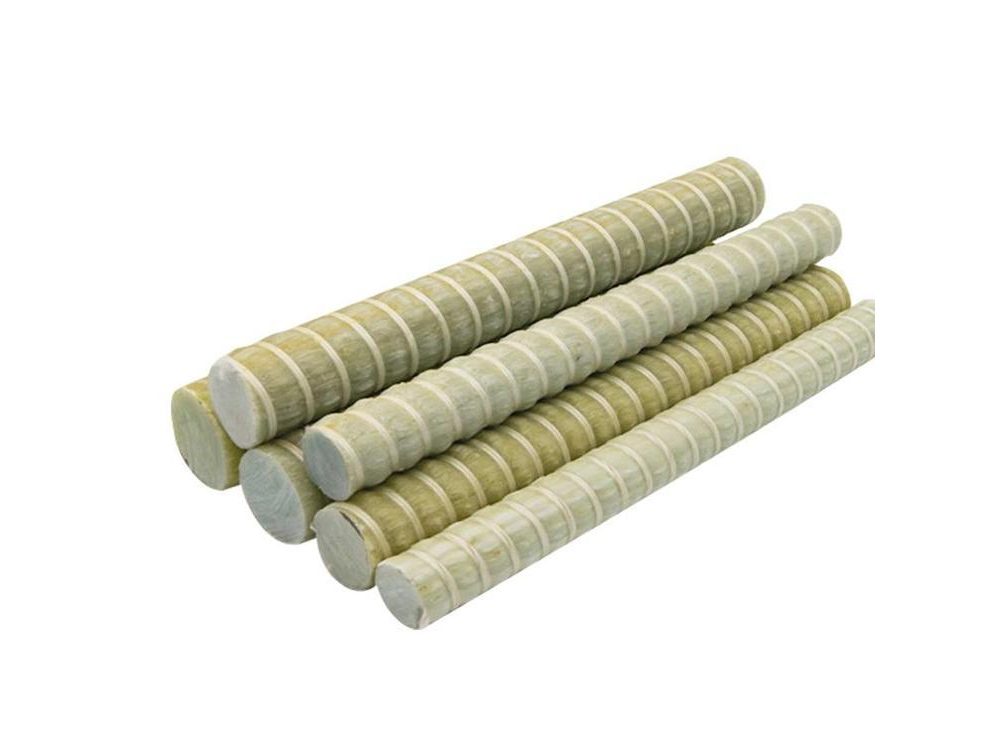
GFRP Rebar
Glass fibre reinforced polymer rebar used as non-prestressed reinforcement in concrete where corrosion of steel governs the design life or where electromagnetic transparency is required — bridge decks, marine and port structures, tunnel linings, wastewater and chemical facilities, and MRI or electromagnetically sensitive environments. Supplied in 6 m and 12 m lengths with factory bends and matching accessories.
GFRP reinforcing bar is manufactured by pultrusion of continuous E-CR glass rovings through a vinyl-ester resin bath, with a helical wrap and bonded sand coating applied before curing in a heated die. Sizes span #2 to #10 (6 mm to 32 mm) with cross-sectional areas of 32 mm2 to 819 mm2. Guaranteed tensile strength to ASTM D7205 falls from approximately 1200 MPa at 10 mm to 550-690 MPa at 25-32 mm, with a guaranteed elastic modulus of 45-60 GPa and transverse shear capacity of 150-185 MPa to ASTM D7617.
Design follows ACI 440.11-22, which treats GFRP as linear-elastic to rupture with no yield plateau, so deflection and crack width govern rather than strength. Environmental reduction factors of 0.7-0.8 apply, development lengths run 40 to 80 bar diameters, and site bending is not permitted - factory bends use a minimum radius of 10 times bar diameter. Density is about 2.0 g/cm3, one quarter of steel, giving 30-45 % handling savings. Thermal conductivity of 0.4-0.5 W/mK, electrical insulation and non-magnetic behaviour suit MRI suites, electrified rail zones and desalination structures.
- ASTM D7957 / D7957M — Standard specification for solid round glass fibre reinforced polymer bars for concrete reinforcement, setting minimum tensile strength by bar size, minimum modulus of 44.8 GPa (6,500 ksi), bond strength, moisture absorption and alkaline resistance.
- ASTM D7205 / D7205M — Test method for tensile properties of FRP bars, used to establish the guaranteed tensile strength, elastic modulus and ultimate strain reported on mill certificates.
- ASTM D7913 / D7913M — Bond strength test method for FRP bars in concrete by pullout, giving the minimum bond stress required to qualify a deformation or sand-coated surface pattern.
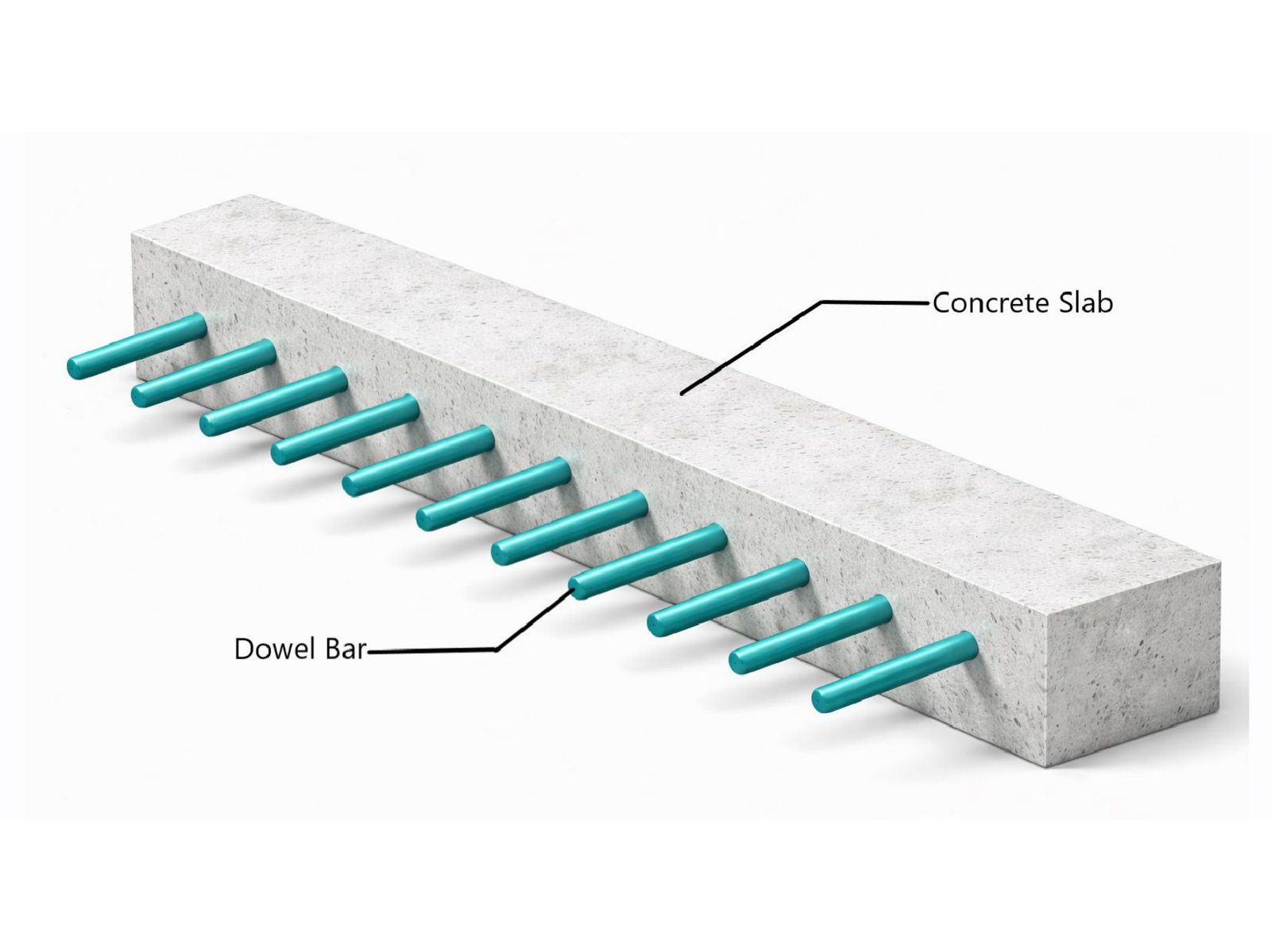
- ASTM D7617 / D7617M — Test method for transverse shear strength of FRP bars, with a guaranteed minimum of 150-185 MPa required for shear-critical elements and dowel action.
- ACI 440.11-22 — Building code requirements for structural concrete reinforced with GFRP bars - covers material limits, flexural and shear design, development length, serviceability and environmental reduction factors.
- AASHTO LRFD Bridge Design Specifications — Provisions for GFRP-reinforced concrete bridge decks and traffic railing, allowing reduced concrete cover and 75-100 year service life assumptions for transport structures.
Design assumptions — modulus, creep rupture and bond — are stated in the submittal so the engineer can check them against the governing code and the specified service life.
- Bridges & highways — bridge decks, approach slabs and barrier walls.
- Marine & coastal works — quay walls, jetties and seawalls in tidal and splash zones.
- Tunnelling & underground — tunnel lining and TBM soft-eye breakthrough zones.
- Desalination plants — intake and outfall structures in continuous seawater contact.
- Water & wastewater — treatment basins and containment walls with permanently wet reinforcement.
- Parking structures — decks and ramps exposed to de-icing and groundwater salts.
- Non-magnetic & electrical zones — MRI suites, substations and rail electrification zones.
- Foundations & slabs — slab-on-grade, foundations and retaining walls on saline or aggressive ground.
- Precast & architectural — façade panels, cladding and architectural concrete with reduced cover.
- Mill test certificate referencing ASTM D7957 with guaranteed tensile force per bar size
- ASTM D7205 / D7617 / D7913 mechanical and bond test reports from an accredited laboratory
- Third-party evaluation report under ICC-ES AC454, including 10,000-hour alkaline ageing and creep-rupture data
- Transport authority or DOT approved product listing for bridge and highway works
- ISO 9001 quality management system certificate
- Environmental Product Declaration (EPD) with declared global warming potential per tonne
- Cutting and factory bending to the reinforcement schedule, with matching chairs, spacers and couplers.
- Design support — section properties, development length and lap splice guidance for the engineer.
- Export packing, FOB / CFR / CIF to Gulf ports/global ports, consolidated with other concrete materials.
Supply references include RA210 in Kuwait, ECRL in Malaysia, E-763 in Serbia and the J.P. Magufuli Bridge in Tanzania, with strand supplied under DM–DCL product conformity certification. Supply references do not establish owner approval; formal acceptance requires product-specific approval on the project. Supplied to projects across the Gulf, North and Sub-Saharan Africa, South-East Asia and Australia. Middle East supplies are subject to project-specific approval by the owner, engineer or consultant; PROTEKTA prepares and supports the submittal package for that approval.
GFRP Rebar — Buyer Questions
What sizes and lengths are available?
Diameters from 6 mm to 32 mm in standard lengths of 6 m and 12 m, with custom lengths available. Factory bends and matching chairs, spacers and couplers are supplied to the reinforcement schedule. Supplied for projects across the GCC — Saudi Arabia, UAE, Qatar, Kuwait, Oman and Bahrain — and to Iraq, Algeria, Morocco, Nigeria, Ethiopia, Tanzania, Malaysia, Thailand, Singapore, Indonesia, Brunei and Australia, with compliance documentation prepared for consultant, contractor and authority submittal.
Which standards and certifications apply to GFRP rebar?
Bars are supplied to ASTM D7957 / D7957M with tensile properties tested to ASTM D7205. Design follows ACI 440.11, with CSA S806 and S807 available for projects on Canadian specifications. Also specified and procured as Glass Fibre Rebar and Composite Rebar; full specification ranges, material grades and datasheets are issued for tender, submittal and procurement use.
Where is GFRP rebar preferred over steel?
Where chloride exposure would corrode steel — bridge decks, marine and port structures, tunnels, wastewater and chemical facilities — and where non-magnetic or electrically non-conductive reinforcement is required, such as MRI suites and research facilities. OEM, private-label and bespoke manufacture is supported for contractors, distributors and EPC packages.
What design information is provided?
Lot certificates with tensile strength, modulus, ultimate strain and bond strength, plus fibre and resin declaration, alkali resistance data, section properties and development length guidance for the governing code. Export packing, third-party inspection and consolidated shipment to Gulf ports/global ports are arranged with the order.